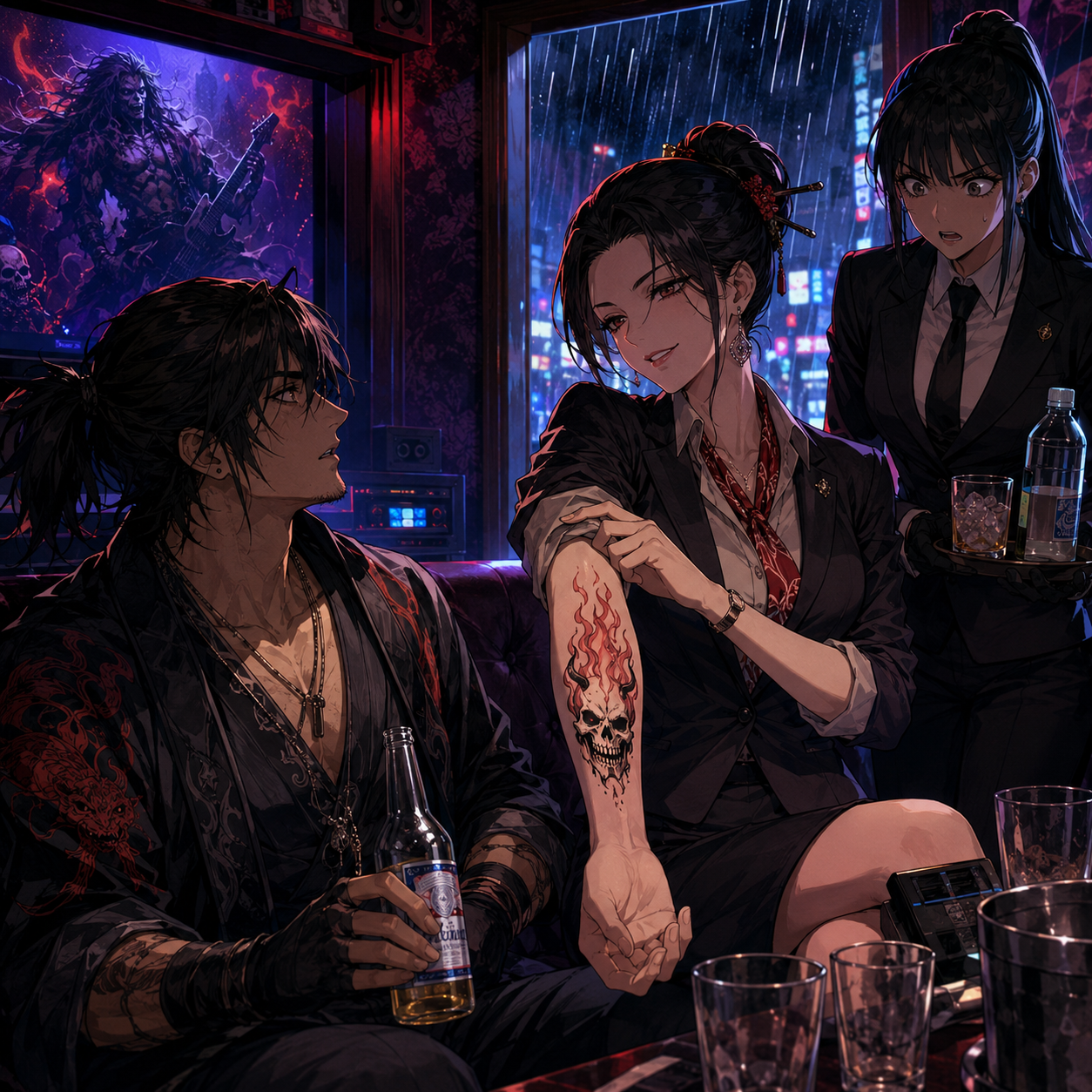
Tokyo drowned beautifully.
Rain fell in silver sheets through the humid summer dusk, turning the neon into long wounds of color across the streets. The city steamed beneath it, alive with engines and footsteps and the quiet violence of things no one says out loud. Above the crowds and below the pavement, in offices and alleys and back rooms, the shadow world was moving. Names passed from mouth to mouth, old debts stirred, and somewhere ancient blood remembered an ancient sin.
And somewhere in the city, the Kazegama had vanished.
The news came to Hattori Michiko behind closed doors, after a long day spent smiling at powerful men who had not yet accepted that they stood beneath her. She returned to her office with Azami at her side, both of them wrapped in the cold discipline of public life. Then her father, Hattori Kiyonobu, appeared with a face like a sealed execution order.
“The Kazegama has been stolen.”
The words landed in the room heavier than the steel they spoke of.
Michiko had known the name only as a story, a bedtime warning. The wind-sickle: a ritual blade, a relic bound to storms and to powers older than her family’s manners. It was the kind of thing people like hers kept buried under politeness and locked doors, the kind of thing that did not exist until the moment it went missing.
Kiyonobu kept his voice level, though anger moved under it. The theft was already several nights old, and the lesser agents sent after it had failed. That meant the thief was no ordinary criminal. Someone had put a true shinobi to work.
He gave them names.
Kido Renji. Sarutobi Hayate. Yagyuu Shinsaku.
All three were ninja of bad reputation, each dangerous in his own fashion, and each one stood close enough to the shadow of the missing blade to be worth hunting.
Michiko’s first instinct was political. Weakness becomes rumor, and rumor draws blood; her rivals would circle the moment they caught the scent. Her father cut that line of thinking off before it could grow teeth.
This was not a matter for cameras or speeches. It belonged to the hidden war.
Azami understood at once, her face sharpening. This was about protection and recovery, about obedience to the family that had taken her in and given her a purpose.
Find the thief, recover the blade, and waste no time.
Elsewhere, beneath the rain-washed twilight, Kido Renji sat alone in a ramen shop.
He looked like a man sunk deep into thought, the kind of man whose silence might conceal unbearable memories or a plan spanning generations. In truth, he was mostly watching the rain and eating noodles.
A man sat down beside him without looking at him, an associate, a stranger to everyone else in the room. He ordered quietly, waited, and spoke only once the clatter of bowls and rain gave them cover.
The Hirazaka Agency was stirred up. Renji’s name had surfaced.
“Watch your back,” the man murmured. “They don’t play nice.”
Renji did not look at him.
“That’s all right,” he said. “Neither do I.”
They finished their bowls in silence, two strangers seated shoulder to shoulder while the city pretended not to notice.
Sarutobi Hayate, meanwhile, was not pretending to be respectable.
He sat in the electric chaos of a pachinko parlor, surrounded by noise and chrome and the seductive rattle of little silver balls. He knew whose territory this was, knew which family owned the place and which debts could wait another day and which ones had teeth. For now his attention belonged to the machine in front of him.
Then the men in dark suits entered.
They were not simple thugs, and they were not true shinobi either, but they were trained enough to stand and search and breathe differently from the men around them. Their eyes moved over the crowd. One held a phone and compared faces against it, and another’s jacket shifted just enough to show the shape of a handgun.
Hayate kept playing.
The men found him.
“Sarutobi Hayate,” one said.
Hayate did not start a fight, not there and not yet. He asked who wanted him. They said only that their employers wished to speak, and that cooperation would be worth his while.
He went with them, stepping out into the wet night and into the back of a black sedan waiting on a narrow street.
Across the city, Yagyuu Shinsaku was also working.
On a balcony across from an apartment, camera in hand and bottle tucked in a paper bag, he photographed a cheating husband with the weary professionalism of a man who had seen too much and still had rent to pay. He had reached the stage of boredom where scandal became paperwork.
Then he noticed the watcher.
On another rooftop, half-hidden in shadow and doing a poor job of it, a young shinobi observed him. Shinsaku shifted his lens and took the picture in a blink. The watcher tried to vanish, retreating with a crude technique and more confidence than skill.
Shinsaku saw through it.
The photograph told him enough: Hirazaka Agency, a junior operative. Someone had pointed a young blade in his direction.
He lowered the camera.
“Hirazaka,” he muttered. “What the hell?”
That question carried him toward Michiko.
Shinsaku started with public information, because every locked door has a hinge somewhere. Michiko’s life had been scrubbed clean: the right appearances, the safe images, the carefully controlled access. She was polished for the public and untouchable by design. But even a manufactured life leaves residue.
She had an online presence, bright and youth-facing, full of harmless tastes and staged familiarity. A favorite restaurant appeared often enough to look like a pattern. Too often, perhaps.
Shinsaku saw the trap. The meal was wrong, the place was wrong, and the Michiko everyone could see was bait.
He followed the inconsistencies instead: the reflected cutlery, the timing, the habits hidden beneath the performance. Eventually, beneath the false trail, he found the real one. A high-end kaiseki restaurant with only a handful of seats, far from the common appetite she pretended to share.
He did not enter. Men like him did not simply walk into places like that.
Instead, a waiter delivered a glass of tea with a cheap business card tucked beneath it.
Yagyuu Shinsaku. Private Detective.
On the back, a note: If you need help, my agency is at your disposal. P.S. the person you had watching me was very bad.
Azami’s eyes narrowed at the card as though it were contaminated.
“I will dispose of this for you, mistress.”
Michiko stopped her. A public meeting with a shabby detective would invite ugly speculation, but ignoring him would be foolish. Someone had found their trail, or at least brushed against it.
“Go out,” Michiko said. “Speak with this man. Find out what he wants.”
Azami left the restaurant with the quiet displeasure of a blade being drawn.
She found Shinsaku near a vending machine, shabby coat, tired eyes, the air of a man who had not slept properly in years. She bought him a Pocari Sweat and handed it over with his card.
“You smell like you need electrolytes.”
Shinsaku accepted the insult with the composure of a man used to worse. He told her what he had seen: someone from Hirazaka watching him, and when his clan became involved, supernatural trouble was usually not far behind. If Michiko needed a good investigator, she knew where to find him.
Azami gave him nothing but politeness sharpened to a point. If help was needed, they would remember.
But Shinsaku had already done what he came to do. The false trails had fallen away, and he knew how to find Michiko now.
The next pursuit was less subtle.
Michiko and Azami went looking for Renji.
They found him in a private karaoke room, alone, not singing. Death metal thundered from the speakers, loud enough to shake the walls. He sat in the dim room as if the noise were weather, drinking an imported Bud Light and listening with complete seriousness.
Azami entered first, carrying drinks as if she belonged there. Michiko followed.
Renji glanced up.
“Counselor?”
The encounter should have been an interrogation, all threat and suspicion. Michiko was hunting a stolen artifact, and Renji was one of the names her father had given her, Bloodline of Oni, a wanderer who carried the smell of destruction and old grudges. Everything about the scene should have bent toward accusation.
Instead, Michiko judged his music.
The band was basic, she said. Loud, yes, but lacking sophistication. Renji, who had seemed immune to most forms of surprise, actually paused.
Then Michiko rolled up her sleeve.
On her inner arm was a tattoo: a flaming skull, tongue out, devil horns raised in defiance. A youthful mistake, maybe, or a secret under the polished surface, a small declaration from the part of her that all those speeches and all that family duty had never quite killed.
Azami watched in restrained horror as her mistress revealed this to a suspicious Oni traveler in a karaoke room.
Renji stared.
For once, his silence had meaning.
He admired it.
Something formed between them, fast and strange, closer to recognition than to trust. Michiko saw beneath Renji’s roughness a soul that could be cultivated, perhaps even educated into better subgenres. Renji saw beneath Michiko’s aristocratic polish a flash of real metal, sharp and absurd and beautiful. Everyone watching expected suspicion. What they got instead was a bond forged out of distortion, tattoos, and terrible beer.
Azami did not approve.
But she said nothing. It was not her place. Her duty was to protect Michiko, even from unexpected friendships with dangerous men who clearly stood below her.
While that unlikely connection sparked, Hayate’s sedan cut through Tokyo traffic.
The men who had collected him sat stiffly, alert and humorless. Rain smeared the windows. The city rushed past in streaks.
Then the driver abruptly cut someone off and slammed the brakes.
The car behind them slammed into the sedan’s rear bumper. Horns erupted, bodies lurched, and the two thugs, too proud for seatbelts, pitched forward in confusion.
The driver started shouting, dragging the first goon out into an argument with the furious motorist behind them. Blame flew, threats followed, and the street turned into a theater of inconvenience.
Then the driver moved.
He was not their driver.
He was Renji.
In the chaos, Renji opened the opposite door, struck the remaining thug, hauled him out, and slid back behind the wheel. Hayate, still in the back seat, had only enough time to understand that his kidnapping had been hijacked.
The sedan tore away into the night, leaving angry men, damaged cars, and unanswered questions behind.
Renji glanced over.
“So. Where to?”
Hayate admitted he did not currently have a place. He had been forcibly relocated before he could settle the matter. He gave his name. Renji gave his.
The name meant something. The death metal ninja, the Oni wanderer, the man who had just turned a kidnapping into an insurance scam and a rescue in a single move.
Hayate had heard of him.
As they drove through the rain-bright city, the talk drifted to the Hirazaka Agency and why its people were collecting names. Both of them had brushed against the same disturbance, each reading the signs in his own way. The future around them shimmered with interference, like two clairvoyant signals crossing in the dark.
For one dangerous second Hayate reached for the shape of fate and caught only turbulence. His vision broke into static, possibility turning sharp and jagged. A lesser man might have lost himself in it.
Hayate steadied himself with a hidden dose from his shinobi kit, forcing clarity back through the fog. The omen resolved enough to matter.
This meeting was not accidental.
Renji had saved him with reckless style. Hayate, cagey by nature and allergic to being owned by anyone, nevertheless felt the pull of devotion toward this strange, cool figure who had appeared exactly when needed. Renji, for his part, found Hayate troublesome but worth the trouble. A friend, perhaps. Or the beginning of something near enough to one.
By the time the stolen sedan disappeared into the deeper arteries of the city, Renji had gained another bond.
He was becoming dangerously popular.
But there was one person near Michiko who did not look at him with admiration.
Renji went looking for Azami.
Not through ordinary surveillance. Ordinary methods were for ordinary people. He reached outward through clairvoyant sight, watching for the moment when Michiko’s bodyguard would step away from her mistress’s side. That moment came during an errand: dry cleaning, while Michiko attended to her public duties.
Azami emerged carrying garments in protective plastic, her black-clad presence at odds with the mundane domesticity of the task.
Renji fell into step beside her.
“A pleasure to see you again.”
Her suspicion was immediate.
“It’s you again. What do you want?”
He asked whether she ever left the counselor’s side. She answered with clipped loyalty. Bodyguard and assistant, almost family. The Hattori household had taken her in when she was six, and Michiko had been like an older sister to her ever since.
Renji listened.
Then he placed a blade where armor was thinnest.
“Have you ever thought about your birth family? Who they might be?”
“They’re dead,” Azami said.
Renji’s voice did not change.
“Not everyone who’s dead actually died.”
Azami stopped walking.
For a moment the city seemed to pull away from them. The rain, the traffic, the dry cleaning in her arms, the duties waiting at the end of the errand, all of it dimmed under the weight of that one sentence. It was absurd and it was cruel, and it was possible in exactly the way the shadow world made terrible things possible.
“What?”
“You heard me,” Renji said.
He left her with that, fading into the crowd after telling her she could find him if she wanted to talk more.
Azami watched him go, mistrust twisting tight inside her chest. She did not believe him. She could not afford to believe him. But the thought had entered, and that was enough.
Renji, impossibly, felt something gentler. Affection, maybe, for the wound he had touched. Or for the strength with which she hid it.
Azami returned to her duties with the sentence following her like a second shadow.
The investigation turned next toward Hayate.
Azami had not forgotten the Kazegama. Whatever strange bonds had formed around Renji, the blade remained missing, and Hayate remained one of the named suspects. Since the agency’s lesser men had lost him, she began with their failure. She extracted what they knew, then descended into the seedier districts where Hayate’s habits had left a trail of debts and noise.
She dressed down, hid her discipline beneath the skin of an ordinary lowlife, and vanished into Pachinko Town.
There, among smoke and light and the endless mechanical rain of silver balls, she found him.
Hayate had tried to keep a low profile. He had also, inevitably, returned to pachinko. Some urges were stronger than caution.
Azami took the seat beside him.
“I hear you have some debts.”
Hayate put another coin in the machine.
“Are you paying them?”
She offered something better than threats: a meeting, tea, questions, and the possibility that her employer might decide his information had value. Hayate, impressed despite himself that she had found him, accepted.
The meeting did not happen in some solemn chamber or noble house.
It happened at Sushiro.
The restaurant was bright and loud and cheap, food arriving on little conveyor carts under animated menus that glowed above the table. It was no place for an investigation into an ancient relic, which made it exactly the sort of place the city would choose. Plates stacked up between them while the tea steamed, and the air smelled of rice and fish and fried things and suspicion.
Michiko and Azami sat across from Hayate.
They wanted the Kazegama.
Hayate asked what they intended to do with it. Azami said they would return it to its rightful place. Michiko said it was used to maintain balance. Hayate pressed the question: what rightful place? Whose balance? Was this a noble retrieval or simply a powerful family reclaiming a powerful weapon?
Azami finally said what had been hidden.
The Kazegama had been protected for generations at the Hattori household.
Hayate claimed he did not have their sword. More than that, he claimed he was learning about it from them. He knew only rumors: an ancient enchanted blade, a thing of storms and ritual power. Not enough to possess it. Not enough to reveal its thief.
Azami listened hard, searching his evasions for the shape of a lie.
She found only frustration.
Hayate was slippery, amused, and unhelpful. Whether he knew nothing or merely gave them nothing, the result was the same. The inquiry slid off him like rain off lacquer.
At last Azami’s patience thinned.
If he had no information, then he had no further use.
The cheap sushi was all he would get.
Night deepened over Tokyo.
By then, each suspect had been touched. Shinsaku had found Michiko’s trail. Michiko had found unexpected kinship with Renji. Renji had rescued Hayate and unsettled Azami. Azami had tracked Hayate down and learned almost nothing. Hayate had slipped through danger with a new devotion and no clear answers.
The Kazegama remained missing.
Somewhere in the city, the wind-sickle waited in hidden hands, a blade that could summon storms and unlock greater rituals. The theft had already drawn the clans into motion. The first probes had been subtle, even strange: business cards, karaoke, dry cleaning, pachinko, conveyor-belt sushi.
But subtlety had limits.
Soon, someone would stop asking questions politely.
And when the shadow world tired of riddles, Tokyo would learn how loudly ninjas could make the rain fall.
Session Notes
-
Luke introduced the game as Shinobigami, a modern ninja battle RPG focused on supernatural ninja, hidden motives, dramatic reveals, and shifting alliances.
- He explained that none of the group had played much recently, so he would introduce rules as they became relevant rather than front-loading all mechanics.
- He noted that the Foundry system being used was a rough, custom-built setup created by him with Codex assistance.
- Because Shinobigami characters have secrets, Luke explained that each character had both public and private sheets in Foundry.
- The public sheets showed general character information, while private sheets contained each player’s full character details, including secret mechanics.
- Luke warned that some sheet tabs contained irrelevant or unfinished fields, and told the players to focus mainly on the Overview, Ninpo and Ogi, and Information tabs.
- He demonstrated that roll outputs in chat had extra information, but the important part was the Outcome line.
-
Luke explained the core premise of Shinobigami.
- The characters are ninja with supernatural powers.
- They may serve different clans and have conflicting goals.
- Players may lie about their goals.
- Characters may not be on the side they initially appear to be on.
- The game is meant to produce dramatic reveals and sudden changes of allegiance.
- Characters can generally describe themselves doing “cool ninja” actions freely, but significant mechanical effects are handled through ninpo, which are ninja techniques.
-
Luke explained character abilities and secrets.
- Every character has a close combat ninpo, which functions as a ninja-powered melee attack.
- Each character also has four other ninpo with varying effects.
- Every character has an Ogi, their secret ultimate technique.
- The first time an Ogi is used against someone who does not know it, it works automatically unless special circumstances apply.
- After someone has seen an Ogi, they can attempt to break or counter it the next time it is used against them.
- Luke emphasized that players usually want to hold back an Ogi until they are ready to use it decisively.
-
Luke explained that each character begins with a mission and a Secret.
- A mission can be discussed openly, and characters can tell the truth or lie about it.
- A capital-S Secret cannot be voluntarily revealed.
- Other characters must use the game’s mechanics to learn a Secret.
- A character can invite someone to investigate their Secret, but the other character still has to use the proper information-gathering mechanics.
-
Luke explained the game’s structure.
-
The session begins with an introduction phase, in which each character is introduced and receives their mission.
-
The game then moves into the main phase, which has three cycles in this scenario.
-
In each cycle, each character gets one scene turn.
-
During a scene turn, the acting character sets up a scene and pursues a goal.
-
The scene eventually culminates in one major scene action.
-
The three major scene actions are:
- Information check, used to learn a character’s Secret or Location.
- Emotion check, used to form an emotional bond with another character.
- Recovery check, used to heal a lost life point or remove a status ailment.
-
A character’s Location means knowing how to find that character later, especially to start a fight with them.
-
Emotional bonds can be positive or negative, and they allow information sharing when bonded characters learn Secrets or Locations.
-
A character with an emotional bond to someone in a battle can join that battle either with or against them.
-
Luke explained the basic skill check system.
- Skill checks use 2d6.
- If a character has the requested skill, the target number is usually 5.
- If they do not have the exact skill, they substitute from their nearest known skill, which raises the target number based on distance on the skill grid.
- The Foundry sheet handles the calculation.
- A 12 is always a success and a critical.
- A 2 is a fumble.
-
Luke explained basic ninpo rules.
- Ninpo include attack, support, information, and equip types.
- In drama scenes, characters generally use only support and information ninpo.
- In combat, more types of ninpo can be used.
- A given ninpo can only be used once per cycle during drama scenes.
- Equip ninpo are passive effects that are always active.
- Luke noted that at least one equip ninpo grants bonus life points, but the sheet did not yet represent those automatically.
-
Luke gave setting background on the six ninja clans.
- Otogi Private Academy is driven to discover the secrets of others and acts like spies or blackmailers.
- The Lost Ones are people with ninja blood whose clans lost track of them; they have powers but no firm clan allegiance.
- Hasuba Ninja Army seeks to learn the Ogi and ninja powers of other clans to become the ultimate ninja clan.
- Kurama Shin Clan wants to prevent the rise of the Shinobigami.
- Bloodline of Oni wants to bring about the coming of the Shinobigami, and some members trace their lineage to supernatural beings such as yokai, oni, vampires, or werewolves.
- Hirasaka Agency protects Japan’s national interests and is heavily integrated with the ruling class and government.
-
Luke explained the significance of the Shinobigami.
- It is an otherworldly godlike entity associated with all ninja.
- Some ninja believe its manifestation would be beneficial.
- Other ninja believe it would kill everyone.
- The Bloodline of Oni previously attempted to summon it.
-
Luke described the recent history of Dejima.
- A few years ago, the Bloodline of Oni assembled a ritual to summon the Shinobigami.
- They opened a gate and began to assert the Shinobigami’s power.
- At the last minute, ninja from every clan, assembled by the Kurama Shin Clan, stopped the ritual.
- The incomplete ritual released uncontrolled magical energy in every direction.
- Many supernatural outsiders emerged into the city, and former inhabitants were transformed into horrors.
- Since then, the city has been physically and magically sealed.
- All records of its existence were erased.
- Attempts to locate it have failed.
- Only ninja of Jōnin rank or higher have meaningful information about it.
- The player characters are lower-ranked shinobi, trusted enough to be sent into the field but not veteran elites.
- Luke adapted Dejima as a vanished island in the port of Nagasaki that could potentially be made to appear elsewhere by sufficiently skilled sorcerers.
-
Luke introduced the available player characters.
- Yagyuu Shinsaku is the detective, a supernatural investigator who has seen the devastation caused by outsiders and uncontrolled sorcery and has vowed to stop it.
- Hattori Michiko is the scion and heir of an aristocratic ninja family.
- Hattori Azami is Michiko’s bodyguard, adopted into the Hattori family and raised to protect Michiko with absolute devotion.
- Sarutobi Hayate is a gambler, thief, and troublemaker, one of the Lost Ones with motives apart from organized ninja politics.
- Kido Renji is a traveler from the Bloodline of Oni, a wandering survivor of a destroyed hidden village, possibly seeking revenge.
-
The players selected characters.
- Robert chose Hattori Michiko, the politician.
- Merideth chose Hattori Azami, the bodyguard.
- Mark chose Sarutobi Hayate, the gambler.
- Brian chose Kido Renji, the traveler.
- Michael chose Yagyuu Shinsaku, the detective.
-
Luke began the in-character story in modern Tokyo during a hot, humid summer rainy season.
- The city was described as a grand metropolis where the characters live, work, and kill for their ninja clans.
- Luke stated that their duties to their clans were being called upon and their loyalties tested.
-
The first introduction scene focused on Hattori Michiko and Hattori Azami.
- Michiko and Azami returned to Michiko’s office after a meeting with powerful men who resented the authority of a young woman.
- Michiko’s father, Hattori Kiyonobu, was waiting with grim news.
- He told Michiko and Azami that the Kazegama, a magical blade and key to powerful rituals, had been stolen.
- Michiko reacted with shock and realized it was the same “wind sickle” she had thought was only a bedtime story.
- Kiyonobu revealed that the Hattori family had kept the Kazegama safe.
- He said he had not told Michiko before because it had not been necessary.
- He tasked Michiko and Azami with finding the thief and recovering the blade.
- Azami immediately accepted the duty.
- Azami asked when the Kazegama had been taken and what they knew.
- Kiyonobu said it had been stolen a couple of nights earlier.
- He had already sent other agents, but it was now clear a skilled shinobi was involved.
- Azami asked whether there were suspects.
- Kiyonobu named Kido Renji, Sarutobi Hayate, and Yagyuu Shinsaku as suspicious ninja of ill repute.
- Michiko worried about who knew of the theft and whether it could leak to the press.
- She considered whether the incident could be pinned on political opponents to gain an advantage in the polls.
- Azami advised against disclosing evidence of the sacred artifact.
- Kiyonobu agreed with Azami and said this was a matter of the shadow world, not Michiko’s public political arena.
- He warned that whoever stole the Kazegama probably intended to use it soon.
- He told them not to waste time and to find the thief.
-
The second introduction scene focused on Kido Renji.
- Renji was at a ramen house, eating ramen alone.
- He watched the rain in the twilight outside while slurping noodles.
- He looked deep in thought, though Brian clarified that this was simply how Renji looked.
- An associate of Renji’s, Yukisada Yuki, sat down on the stool next to him.
- Yuki did not look directly at Renji or indicate publicly that they knew each other.
- While waiting for his own bowl, Yuki quietly warned Renji that the Hirasaka Agency was agitated about something.
- Yuki said he had heard Renji’s name mentioned in connection with it.
- Yuki told Renji to watch his back because the Hirasaka Agency did not play nice.
- Renji replied that this was all right, because neither did he.
- The two finished their noodles in silence, appearing to the world as strangers.
-
The third introduction scene focused on Sarutobi Hayate.
- Hayate was at the pachinko machines.
- Luke described him as knowing which Yakuza family owned the parlor and perhaps running a scam there.
- Hayate was racking up points toward a large prize.
- He noticed men in dark suits scanning the crowd.
- They appeared to work for another organization.
- They were not true shinobi, but they had some basic ninjutsu training and were more than ordinary Yakuza thugs.
- Hayate continued playing pachinko while discreetly watching where they went and whom they were searching for.
- The men eventually identified Hayate from a photo on a phone.
- One of them revealed a handgun in a shoulder holster.
- They approached him carefully and called him by name.
- They told Hayate that their employers wanted to speak with him.
- They instructed him to stand up and walk out the front.
- Hayate asked who their employers were.
- They said their employers would make it worth his while and warned him not to anger powerful people.
- Hayate agreed to go with them.
- His introduction ended with him getting into the back of a black sedan on a narrow street outside the pachinko parlor.
-
The fourth introduction scene focused on Yagyuu Shinsaku.
- Shinsaku was on a balcony across the street from an apartment.
- He was taking photographs of a cheating husband as part of a private investigator case.
- He had reached the balcony by ninja means and was using a telephoto lens.
- He had a bottle in a brown paper bag and was drinking from it while bored.
- On another rooftop across a corner from him, Shinsaku noticed a figure lurking in the shadows.
- The figure was not hiding expertly, but had some training.
- The person appeared to be surveilling Shinsaku while he was surveilling his target.
- Shinsaku quickly redirected his camera and took a photo of the watcher.
- The watcher attempted to vanish from sight with a technique.
- Shinsaku saw through it.
- From the photograph, he identified the watcher as wearing the garb of a Hirasaka Agency genin.
- The watcher seemed like a junior or still-training shinobi.
- Shinsaku noted the Hirasaka connection and intended to ask questions.
-
The main phase began with the first cycle.
- Luke reminded the group that each character would get a scene.
- Michael chose to have Shinsaku investigate why the Hirasaka Agency was active and why they were watching him.
- Since Michiko was a high-profile member of the Hirasaka Agency, Shinsaku chose to investigate Hattori Michiko.
-
Yagyuu Shinsaku’s first scene focused on investigating Hattori Michiko’s Location.
- Shinsaku began by looking at Michiko’s public work and movements.
- He investigated what she had been voting on, where she had been, her public appearances, and her habits.
- He began with cyber-stalking rather than physical surveillance.
- Luke stated that Michiko’s public information had been carefully scrubbed.
- Shinsaku could infer the general wealthy part of the city where she likely lived and found some public sightings, but nothing simple or direct.
- Shinsaku rolled Investigation and succeeded.
- Luke said the success meant Shinsaku discovered a restaurant that Michiko frequented.
- Robert and Merideth were allowed to establish whether the restaurant information was a honeypot.
- Michiko’s public-facing social media presented a favorite restaurant and favorite meal, but those were false.
- The fake public favorite was deliberately used to watch for suspicious people.
- Michiko attempted a Trap roll to make the honeypot work.
- Michiko failed the Trap roll.
- Because Shinsaku succeeded and Michiko failed, Shinsaku saw through the trap.
- He realized that the restaurant on Michiko’s social media was not her true favorite.
- He identified the actual restaurant Michiko frequented: a high-end kaiseki restaurant that seats very few people per night.
- Rather than enter the restaurant himself, Shinsaku gave one of the waitstaff his detective business card.
- He had the waitstaff present the card to Michiko with a note on the back.
- The note said that if she needed help, his detective agency was at her disposal.
- It also said that the person she had watching him was very bad.
- Azami offered to dispose of the card for Michiko.
- Michiko told Azami not to throw it away.
- Michiko worried that being seen with a detective could create rumors of an investigation.
- She sent Azami outside to find out what Shinsaku wanted.
- Azami found Shinsaku near a drink machine.
- She bought him a Pocari Sweat and told him he smelled like he needed electrolytes.
- She returned his card and asked what he wanted.
- Shinsaku said that when the Hirasaka Agency is involved, something supernaturally bad is usually on the horizon.
- He told Azami that if they needed help, they knew where to find him.
- Azami said they would keep him in mind if they needed help.
- Shinsaku asked how the restaurant was, noting he had heard it had great reviews but could not get in.
- Luke confirmed that Shinsaku’s scene action was to learn Michiko’s Location.
- Because his earlier Investigation roll had succeeded, Shinsaku learned Hattori Michiko’s Location.
- Luke marked on the sheet that Shinsaku knew how to find Michiko and could engage her in combat later if desired.
-
Hattori Michiko’s first scene focused on forming an emotional bond with Kido Renji.
- Michiko decided to investigate one of the theft suspects.
- She chose Kido Renji, reasoning that the Oni traveler was a natural suspect.
- Renji was not hiding.
- Renji was at a karaoke bar.
- He had rented a private karaoke room alone.
- He was not singing; he was listening to loud death metal music.
- Michiko brought Azami with her.
- Azami suggested that they take Renji’s drink order to him as a pretext to enter.
- Azami bribed the karaoke establishment staff with money and took over delivery of the drinks.
- Azami knocked on Renji’s door and announced that his order had arrived.
- Azami and Michiko entered the karaoke room carrying drinks.
- Renji recognized Michiko and addressed her as “Counselor.”
- Renji took his drink, which Brian specified was Bud Light.
- Michiko commented that the band Renji was listening to was rather basic.
- Renji said he liked loud things.
- Michiko said she was more of a technical death metal connoisseur.
- Michiko asked whether anyone had ever called Renji a poser.
- Renji answered, “Every day.”
- Michiko said she understood liking what one likes.
- She pulled up her sleeve and revealed a tattoo on her inner arm.
- The tattoo was a flaming skull with its tongue out and devil horns.
- Renji was genuinely surprised and taken aback by the tattoo.
- Michiko joked that Renji now knew her secret, clarifying that this was only a lowercase secret.
- Michiko’s actual intent was to create an emotional bond with Renji.
- She reasoned that Renji was too obvious a culprit to be the real thief and that bonding with him might help her find the real thief.
- Luke called for an Emotion check.
- Michiko rolled Manipulation and succeeded.
- Because of the successful Emotion check, Michiko and Renji each rolled for the type of emotional bond.
- Michiko rolled a 6, giving her the choice between Devotion and Murderous Intent toward Renji.
- Michiko chose Devotion.
- Renji rolled a 5, giving him the choice between Admiration and Inferiority toward Michiko.
- Renji chose Admiration.
- The characters formed a positive emotional bond.
- Luke explained that because of the bond, information sharing between them was enabled.
- If either of them directly learned information later, the other would learn it too.
- Luke clarified that information does not daisy-chain through multiple emotional bonds.
- Azami was present and surprised by the bonding.
- Merideth described Azami as a little disappointed because Renji seemed obviously below her mistress, but it was not Azami’s place to say so.
-
Sarutobi Hayate’s first scene began with his abduction and turned into a rescue by Kido Renji.
- Hayate was in the black sedan being driven across town by Hirasaka-associated goons.
- Mark initially wanted Hayate to form a bond with Shinsaku, but that was difficult to justify from the current situation.
- Mark instead decided to attempt a bond with Renji.
- Luke asked whether Renji was willing to intercept the vehicle.
- Renji agreed.
- Renji was secretly already in the vehicle as the driver, disguised as one of the goons.
- Luke called for a stealth-related roll.
- Renji rolled Infiltration and succeeded.
- This established that Renji had planned ahead and had been driving the goons all along without them realizing it.
- Renji cut someone off in traffic and braked hard, causing the sedan to be rear-ended.
- The goons, who were too tough to wear seatbelts, were thrown forward by the impact.
- Honking erupted around them.
- Renji got out and started an altercation with the driver behind them.
- He used the situation to draw one of the goons out of the car.
- Renji then opened the other door, punched out the remaining goon, got back into the car, and drove away with Hayate still inside.
- The goons were left behind as Renji and Hayate escaped into Tokyo.
- Renji asked Hayate where he wanted to go.
- Hayate said he did not know, because he had been forcibly taken and had not arranged a place to stay.
- Hayate introduced himself.
- Renji introduced himself as Renji.
- Hayate said he had heard of Renji and was pleased to meet him in person.
- Hayate attempted to form an emotional bond with Renji.
- The two discussed possible supernatural or reputation-based reasons for the bond.
- Hayate’s reputation for Clairvoyance was chosen as the basis.
- Hayate rolled Clairvoyance and fumbled with snake eyes.
- Because of the fumble, Hayate rolled on the fumble table.
- He rolled a 2, causing him to lose one piece of ninja gear.
- Hayate had not yet filled in his ninja gear, so he chose a Soma Pill and immediately used it to reroll.
- Hayate then succeeded on the rerolled Clairvoyance check.
- Luke described that Hayate’s reputation for clairvoyance was real, but the future was turbulent until the ninja pill clarified his vision.
- Hayate and Renji rolled for emotional bond types.
- Hayate rolled a 6, giving him the choice between Devotion and Murderous Intent toward Renji.
- Hayate chose Devotion.
- Renji rolled a 2, giving him the choice between Friendship and Anger toward Hayate.
- Renji chose Friendship.
- Luke marked the emotional bond between Hayate and Renji.
- While driving, Renji asked Hayate whether he had also been looking into the Hirasaka Agency and whether they were looking for him.
- Renji said the Hirasaka Agency was looking for something, though he did not yet know what.
- Renji added that it was always fun to play with them.
- Hayate replied that it was possibly both: they might be looking for him, and he might be looking into them.
-
Kido Renji’s first scene focused on finding and emotionally unsettling Hattori Azami.
- Renji decided to seek out Azami.
- Azami was not easy to find because she was usually near Michiko and rarely off-duty.
- Renji had already met her, so he used Clairvoyance to surveil her periodically and find a moment when she was away from Michiko.
- Renji rolled Clairvoyance and succeeded.
- Azami was briefly away from Michiko, picking up Michiko’s dry cleaning while Michiko was occupied with legislative duties.
- Renji appeared and walked alongside Azami as she left with dry cleaning.
- He greeted her and said it was a pleasure to see her again.
- Azami looked suspicious and asked what he wanted.
- Renji said he was curious whether she ever left the counselor’s side.
- He looked at the clothes and noted that she had other colored clothing.
- Azami clarified that the clothes were not hers.
- Renji said it did not seem like her style to steal.
- Azami asked whose dry cleaning he thought she would be picking up.
- Renji said he thought she was Michiko’s bodyguard.
- Azami replied that she was also Michiko’s assistant.
- Azami said Michiko was like an older sister to her.
- She explained that the Hattori family had taken her in.
- Renji asked how old she had been when they took her in.
- Azami said she was six years old.
- Azami said the Hattori family had been very good to her and that was why she was protective of them.
- She again asked Renji what he wanted.
- Renji said he wanted to talk to Azami herself, not just to the counselor.
- Renji attempted to form an emotional bond with Azami.
- The conversation centered on Renji planting an unsettling idea in Azami’s mind.
- Renji asked whether she had ever thought about her birth family and who they might be.
- Azami said they were dead.
- Renji replied, “Not everyone who’s dead actually died.”
- Azami stopped walking and stared at him.
- Luke allowed Renji to roll Inception for the Emotion check.
- Renji succeeded.
- Renji and Azami rolled for emotional bond types.
- Renji rolled a 3, giving him the choice between Affection and Envy toward Azami.
- Renji chose Affection.
- Azami rolled a 1, giving her the choice between Empathy and Mistrust toward Renji.
- Azami chose Mistrust.
- Renji told Azami to think about what he had said and that if she wanted to talk more, she could probably find him.
- He then walked off and disappeared into the crowd.
- Azami muttered that she was sure she could find him.
-
Hattori Azami’s first scene focused on investigating Sarutobi Hayate and the missing Kazegama.
- Azami wanted to look into the disappearance of the Kazegama.
- She noted that she and Michiko had not yet spoken to Hayate, who had been one of the suspects named by Kiyonobu.
- Azami suggested to Michiko that they seek Hayate out and talk to him.
- Luke established that the timeline had moved forward: Hirasaka flunkies had found Hayate, picked him up for questioning, and then lost him after he escaped or stole the car.
- Hayate was trying to keep a low profile and did not want to be found again.
- Azami decided to track him down through the place where the goons had originally found him: the pachinko parlor.
- The failed goons were questioned and forced to reveal other places Hayate was known to frequent.
- Luke stated that Hayate had debts throughout the seedier parts of town and regularly appeared around the pachinko scene.
- Azami went to that area to watch for him.
- Luke called for a skill check related to blending in and spotting Hayate.
- Azami rolled Disguise and succeeded.
- Dressing down to look like a common criminal, Azami successfully blended in.
- Hayate, despite keeping a low profile, went back to play pachinko.
- Azami spotted him entering a pachinko parlor.
- Azami took the seat next to Hayate and said she had heard he had debts.
- Hayate asked whether she was paying debts.
- Azami said she worked for someone who might help him with those debts if he helped them with information.
- Hayate asked what kind of information.
- Azami began to ask where he had been on the night of the theft, then shifted tactics.
- She invited him to have tea with her and her boss at a nice, aboveboard restaurant.
- She said they would ask a few questions, Michiko would decide how much the information was worth, and then Hayate could go on his way.
- Hayate accepted, impressed that Azami had tracked him down so effectively.
-
Azami, Michiko, and Hayate met at Sushiro.
- Luke described Sushiro as a loud, high-tech belt sushi chain with touch screens, conveyor belts, and food delivered directly to the table.
- Azami, Michiko, and Hayate sat together in a booth.
- Azami said they wanted to know the whereabouts of the Kazegama.
- Hayate asked what the artifact was.
- The Kazegama was identified as the wind sickle.
- Luke clarified what Hayate knew about it from rumors.
- Hayate knew the Kazegama was an ancient, centuries-old enchanted blade.
- It was said to be capable of summoning storms.
- It could be used as a key component in larger rituals.
- Hayate asked whether it was known to belong to the Hirasaka Agency or the Hattori family.
- Luke stated that it was not widely known who possessed it, because public knowledge would have made it a target for theft.
- Hayate asked what Michiko and Azami would do with the Kazegama if they found it.
- Azami said they would return it to its rightful location.
- Hayate asked what its rightful location was.
- Michiko said it had belonged where it had been kept for generations.
- Azami clarified that this was the Hattori family household, where it had been protected.
- Hayate said he did not have the sword.
- Azami asked whether he had heard anything about it.
- Hayate said he was learning about it right then and had only heard that it was used for magical rituals.
- Michiko asked who had told him that.
- Hayate asked whether they intended to perform magical rituals with it.
- Azami repeated that her only interest was in returning it to its rightful place, where it could be protected.
- Azami concluded that Hayate had no information about it and that they had no further use for him.
- Luke asked what major scene action Azami intended.
- Azami chose an Information check.
- Luke suggested the check fell under the scheming or strategy area, possibly Manipulation, Investigation, or Bluff.
- Azami rolled Investigation.
- The roll failed.
- Luke described Azami as questioning Hayate while he remained evasive.
- She tried to get a read on him but could not determine what he knew.
- Azami therefore failed to learn useful information from Hayate.
-
The session ended after the first cycle had mostly concluded.
- Luke summarized that about a day had passed since Michiko and Azami learned the Kazegama was missing.
- The Hattori side had interacted with all three named suspects but still did not know who had the Kazegama.
- Luke suggested that they might need to step up their tactics or get rough in future scenes.
- Azami joked about starting by beating Hayate up in the Sushiro.
- Luke noted that further investigation would continue next time.
-
Luke clarified important scenario mechanics after the session’s main action.
- The Kazegama is a Prize in this scenario.
- A Prize is an item that can be taken from another character.
- One character has the Kazegama or at least knows where it is.
- If someone engages the character who owns the Prize in a fight and defeats them, they can take it.
- Before the final scene, combat usually ends for a character when they first take damage.
- The winner of such a fight is the last person standing.
- In the final scene, combat can escalate to death or incapacitation.
- Luke also clarified that investigating a character’s mission is different from learning their capital-S Secret.
- A character’s Secret requires the formal information-gathering scene action.
- A character’s mission can potentially be learned through ordinary play and a regular roll if the approach makes sense.